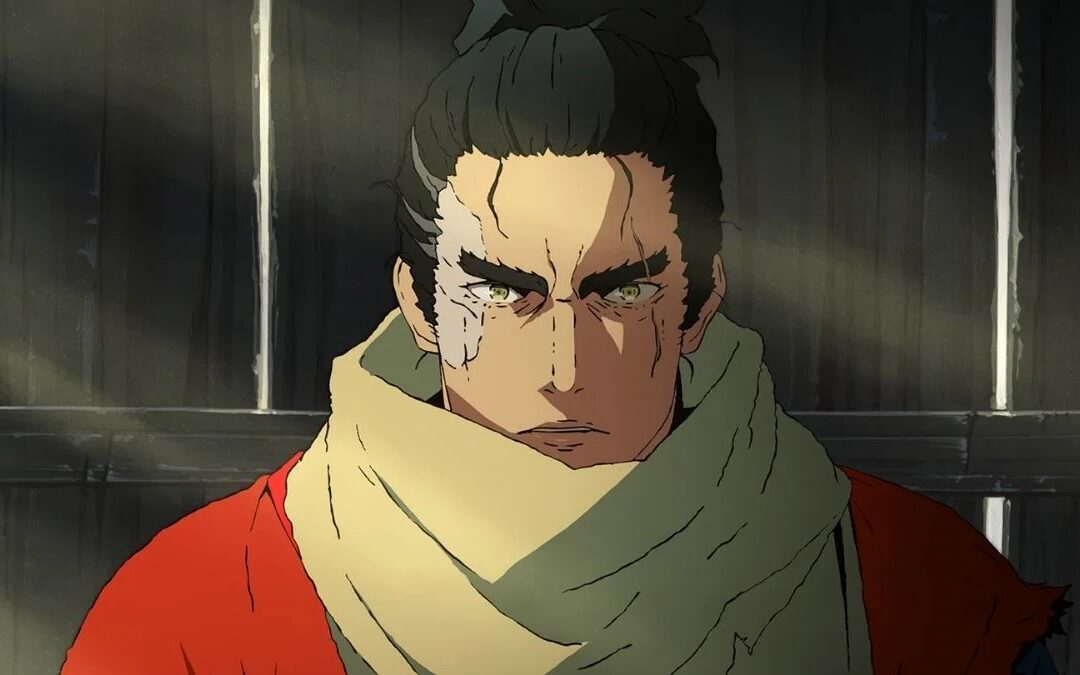
The long awaited anime adaptation of FromSoftware’s Sekiro: Shadows Die Twice is making the rounds again! Since September 4th and the national release of a theatrical version, Japanese fans are getting an exclusive peek at Sekiro: No Defeat. Must the rest of the world sit and wait for the TV version to come out? NO!
All the way from last year’s Aichi Nagoya International Animation Film Festival (ANIAFF), we bring you an eleventh hour report of the Sekiro WIP, one last chance to learn more about the project and the core members of its staff.
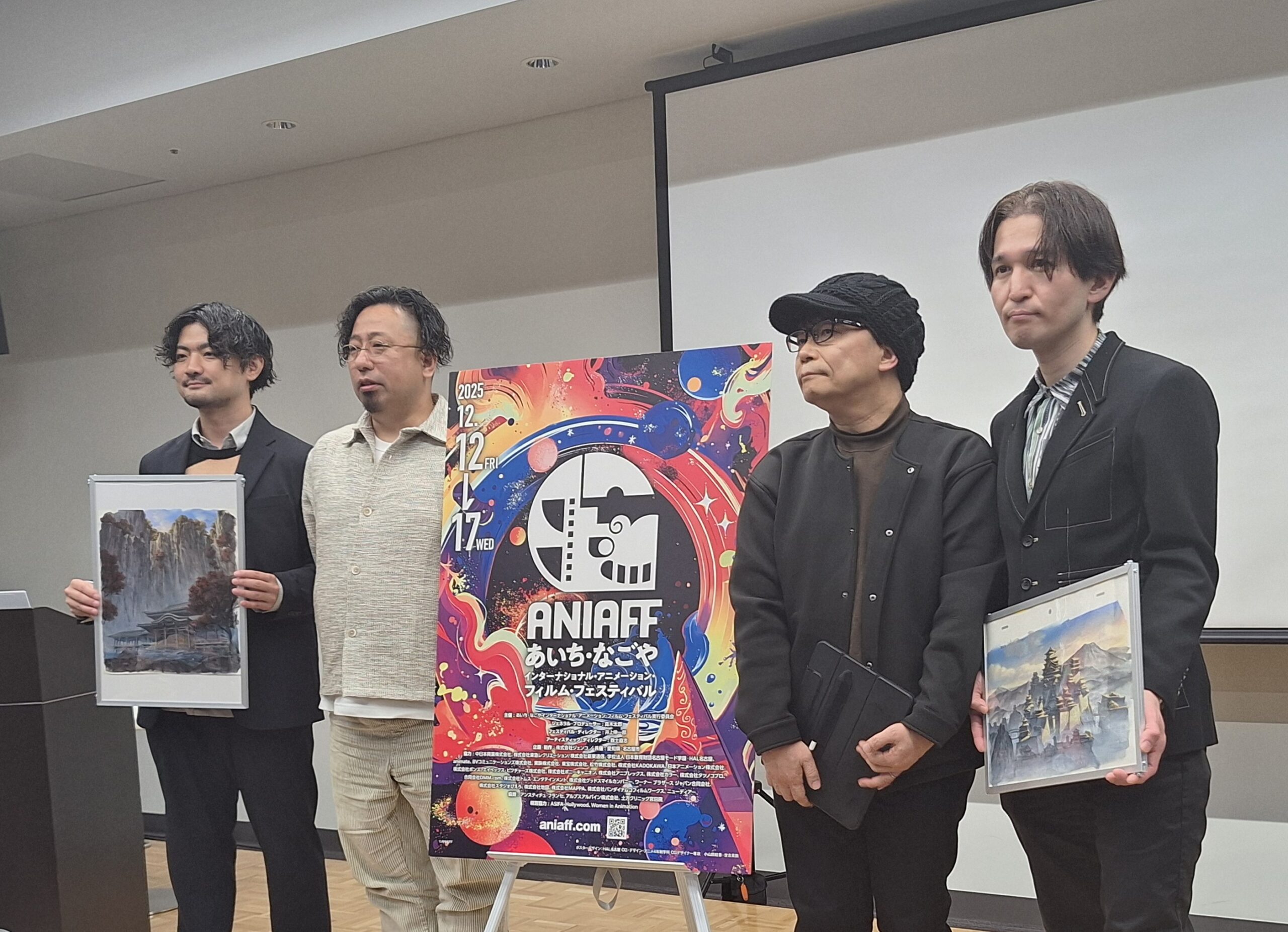
Featuring, from left to right:
- Shun Fukudome (animation producer, Qzil.la president)
- Ken’ichi Kutsuna (director)
- Takuya Satō (script)
- MC: Tetsushi Suzuki (producer, ARCH president and representative director)
This article would not have been possible without the help of our patrons!
If you like what you read, please support us on Ko-Fi! Get extra perks by subscribing to a monthly membership!
Ken’ichi Kutsuna meets Sekiro
The main protagonist of this production, Ken’ichi Kutsuna, is no ordinary director. One of the three most prominent members of the infamous “webgen”, this pioneer of digital animation spent the last few years proving he was also a talented director with three magnificent openings (namely Vlad Love’s opening 1, The Fire Hunter’s and Magical Destroyers’). Sekiro: No Defeat marks his debut as an anime director, hopefully the first of many projects to come.
You can read our interview with Ken’ichi Kutsuna for a deeper dive into his career, but for the TLDR, he opened the talk with a quick self-introduction, as follows.
While Doraemon was his first experience of animation, Kutsuna really fell in love with anime watching Mobile Suit Gundam: Char’s Counterattack, where he discovered two of Japan’s greatest animators: Mitsuo Iso and Shinya Ōhira. Then came Macross Plus, where he witnessed his first “Itano circus”, and the shock of The End of Evangelion.
This quickly became a passion for Kutsuna, who drew flipbooks and aimed for a career in the anime industry. Here, the web proved an essential tool, and not just for reading Animestyle: while still a highschooler, Kutsuna built his personal website, where he uploaded short animations made with Adobe Flash. He also started hanging out on 2channel, a foundational forum for Japanese anime fans of the early 2000s.
It’s around this time that he met Ryo-Timo (a fellow future member of the webgen trinity we had the amazing opportunity to interview) and Yūki Hayashi. The three of them would soon be called by director Osamu Kobayashi to make their industry debut on Beck: Mongolian Chop Squad. While Hayashi then pursued a fairly “classic” career, Kutsuna and Timo went to work at Satelight, where they met Shingo Yamashita—the third musketeer—as well as animator Norio Matsumoto, whose tutelage allowed them to develop the pioneering animation style that would make them known as the “webgen”.
For those curious, famous examples of this style include Birdy the Mighty:Decode (particularly season 2 episode 7), the infamous Naruto vs Pain fight from Naruto: Shippuden animated by Shingo Yamashita and the Yozakura Quartet:Hoshi no Umi/Tsuki ni Naku/Hana no Uta trilogy.
Kutsuna himself talked extensively about this throughout his career, most notably in Atarashii Sakuga (“A New Sakuga”), a dōjinshi/manifesto co-authored with Yamashita and reissued from time to time by the good people at the st.BREAK dōjin circle, as well as in The history of ANIME SAKUGA 2000-2019 told by a SAKUGA Buff, a feature-length interview conducted by Animestyle’s Yūichirō Oguro (who was in the audience!). And also in our interview.
Back to the talk, Kutsuna added to his self-intro a short list of his most prominent influences. As an animator, that’s Satoru Utsunomiya’s work on Gosenzo-sama Banbanzai!, and Norio Matsumoto’s action scenes on Naruto, which he strives to recreate.
As a director, there’s Mamoru Oshii, world-renowned animation and live-action director of Gosenzo-sama Banbanzai!—since we’re on it—and The Sky Crawlers, which was screened three years ago at ANIAFF’s older brother, the Niigata International Animation Film Festival, giving us the extremely rare opportunity to interview him about it! It’s a small world after all… Kutsuna is also a fan of Soviet director Andreï Tarkovski (a favorite of Oshii’s as well) and Nouvelle Vague French director Jean-Luc Godard, for his framing.
Qzil.la and ARCH: A New Animation?
With this, the discussion moved on to the other side of Sekiro: No Defeat, that is the animation studio Qzil.la (pronounced “ku-ji-ra”, “the whale”, written so it auto-links to their super classy new-gen website that I can’t scroll down without my laptop catching on fire). Mic to Shun Fukudome, the fashion-savvy founder and CEO of the studio. A former Production I.G producer, he explains that he founded Qzil.la in 2021 so he could make high-quality, “dope” (he said “dope”) animation. To his credit, Sekiro does look very dope.
Qzil.la, home to many former I.G and MAPPA employees, first focused on commercial shorts and MVs, until Fukudome met Kutsuna and ventured into a first TV series, an action-oriented project that later became a Sekiro tie-in. In addition to this long-brewing production, Qzil.la co-produced other TV anime that were released in 2026, but Sekiro: No Defeat stands out as their first solo work of such scale, and quite a daring one at that.
The conjunction of Kutsuna and Fukudome seems to draw the lines of a “progressive” outlook on anime, that aims at reframing the industry standards. This isn’t an isolated case: many studios in the last few years have looked for ways to emancipate from methods increasingly seen as outdated. Qzil.la is still a young studio with everything to prove, and up until now, this stance could’ve seemed a little superficial: flashy bilingual website, tech-positive attitude and “global” mission do make the recipe for investor bait. Much like Fukudome himself, Qzil.la is dressed to impress, but can they back it up?
Part of the answer lies in another major actor of this project: production company ARCH. Founded in 2017 by Nao Hirasawa, ARCH holds the same cool website/tech-positive/global stance as Qzil.la, and has proved that it isn’t just for show. Since creation, they’ve done pretty much everything from animated content for YouTubers, to theatrical movies, to Jujutsu Kaisen promotional works. While their name remains mostly unknown by anime fans, they’ve been trying their hand at all types of anime-related projects, whether inside or outside the confines of Japan. Not to mention Nao Hirasawa, while still a board director at ARCH, is also the president and representative director of prominent digital studio Graphinica, which conveniently handled photography on Sekiro.
Hirasawa has a distinctive business acumen and all-encompassing view of the anime industry, built by years of experience in copyright law at Bandai, then under the tutelage of Production I.G’s Mitsuhisa Ishikawa, which he recounts in our video interview. The I.G connection might also be how he originally met Fukudome, although this is pure speculation.
Still, public success of the kind that would place ARCH’s name on the map for good has seemingly eluded Hirasawa and his associates. But with an adaptation of a hit game like Sekiro, this could all change. So while it isn’t a make-or-break project as it might be for Qzil.la and Kutsuna himself, Sekiro: No Defeat is still very much a big deal for ARCH, as shown by the direct implication of Hirasawa (as executive producer) and company president and representative director—not to mention the MC of this talk—Tetsushi Suzuki (as producer).
If anything, the show’s visual ambition displays this concern, bringing together an all-star staff for a well-researched project that Kutsuna then set out to explain.
This is Sekiro: No Defeat
So, first things first, Kutsuna played the game. There, he was struck with the care that went into building a sense of “Japanese beauty” into the designs and landscapes, beyond the action itself. This became the foundation of his vision for Sekiro.
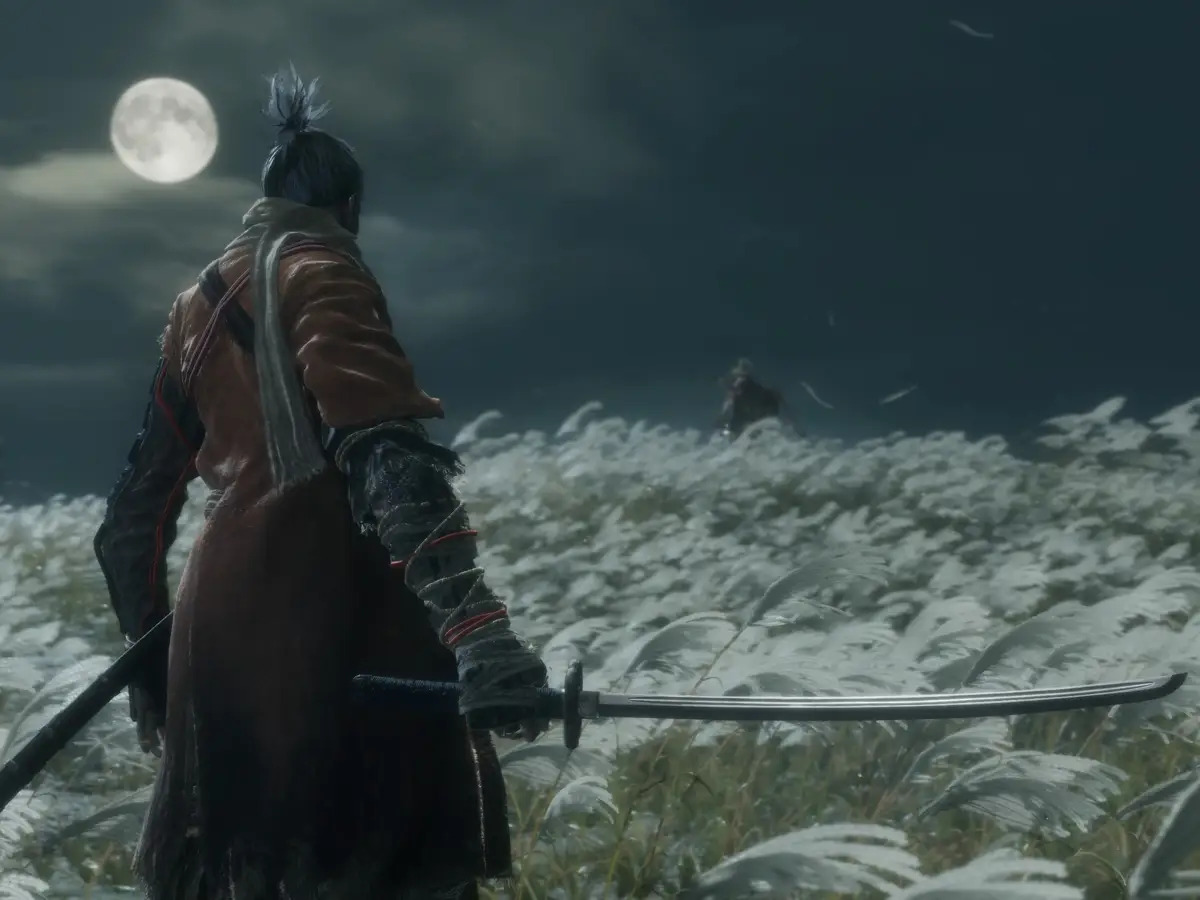
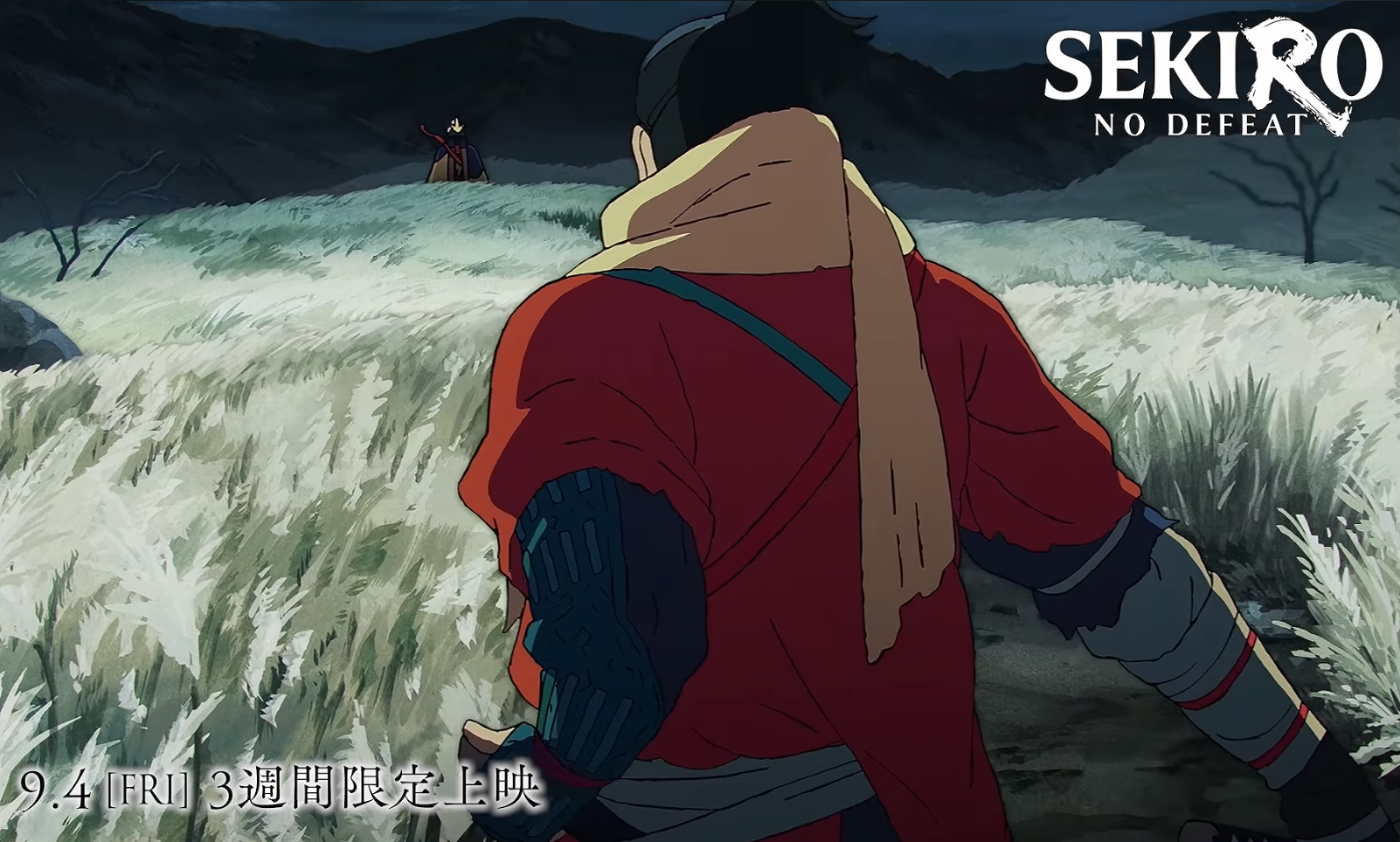
Duel in a field of susuki, a classic motif of Japanese period dramas, as seen in the game and the anime
The first person he recruited was the scriptwriter, Takuya Satō. Satō is a swiss-army knife of sorts, an animator turned director and scriptwriter, as well as sound director on some recent projects. While he is most well-known in the West for directing Steins;Gate, it’s his directorial debut, NieA_7, that caught the attention of Kutsuna, who loved the very “natural” character interactions in Satō’s scripts for the series. So he DMed him on social media to offer him the job.
Satō took the mic to explain his side of the story: while he’s never really been a gamer, he’s always loved FromSoft games, and Kutsuna’s vision for Sekiro felt right up his alley. The working conditions were also ideal: Kutsuna wanted to work with a single scriptwriter for the whole series, and fully entrusted Satō to carry out his job. He treated other department heads the same way, giving them full responsibility for their teams.
Next in line: character designer Takahiro Kishida. While younger fans know him for HAIKYU!!, he crossed paths with Satō much earlier in his career, as the chara designer (and more) of Serial Experiments Lain. Later, he joined Satelight, where he met Kutsuna, who called him for Sekiro because he wanted rich designs that could reflect the characters’ emotional depth. And according to the director, Kishida is the second best in the industry at this (behind Kazuchika Kise!).
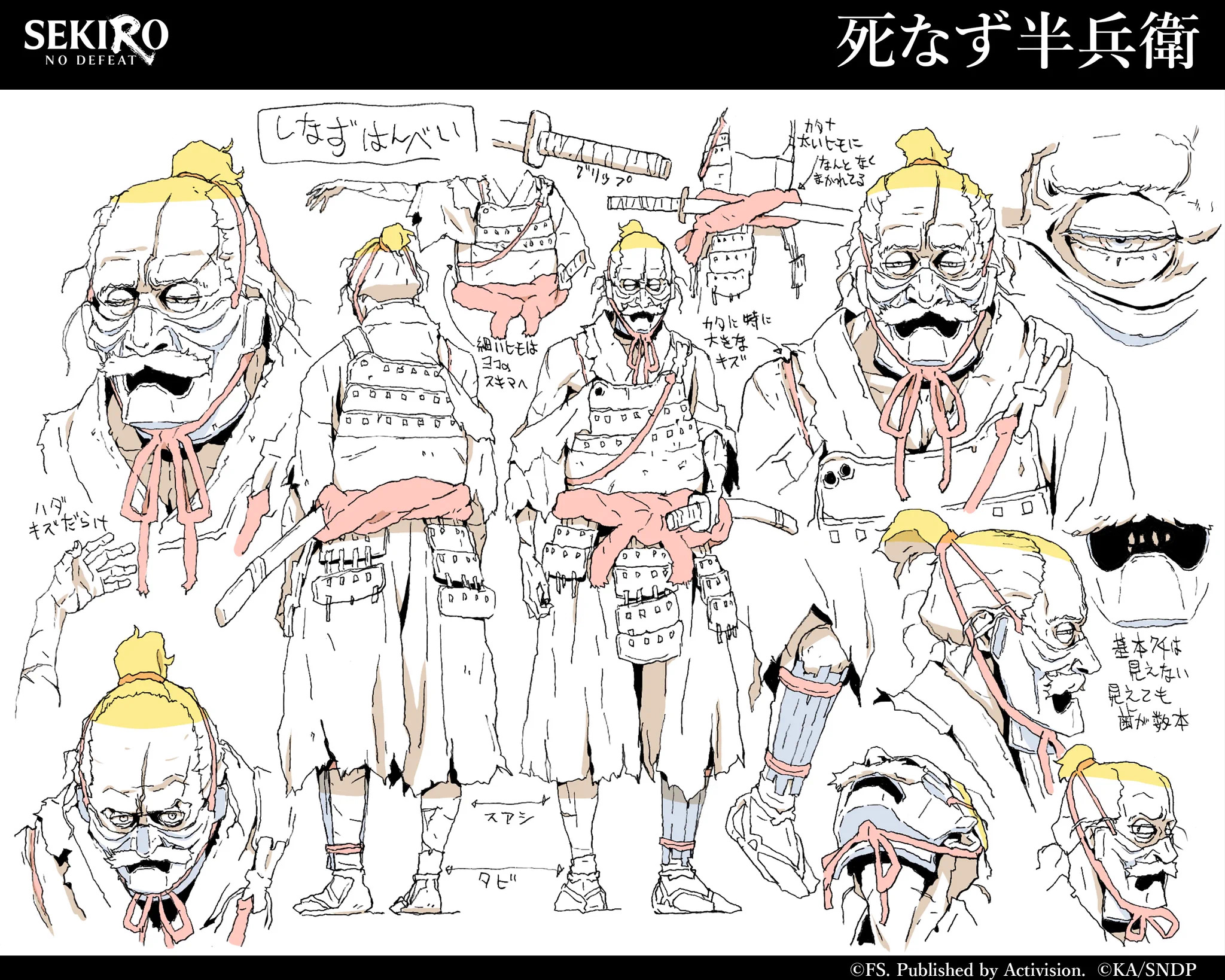
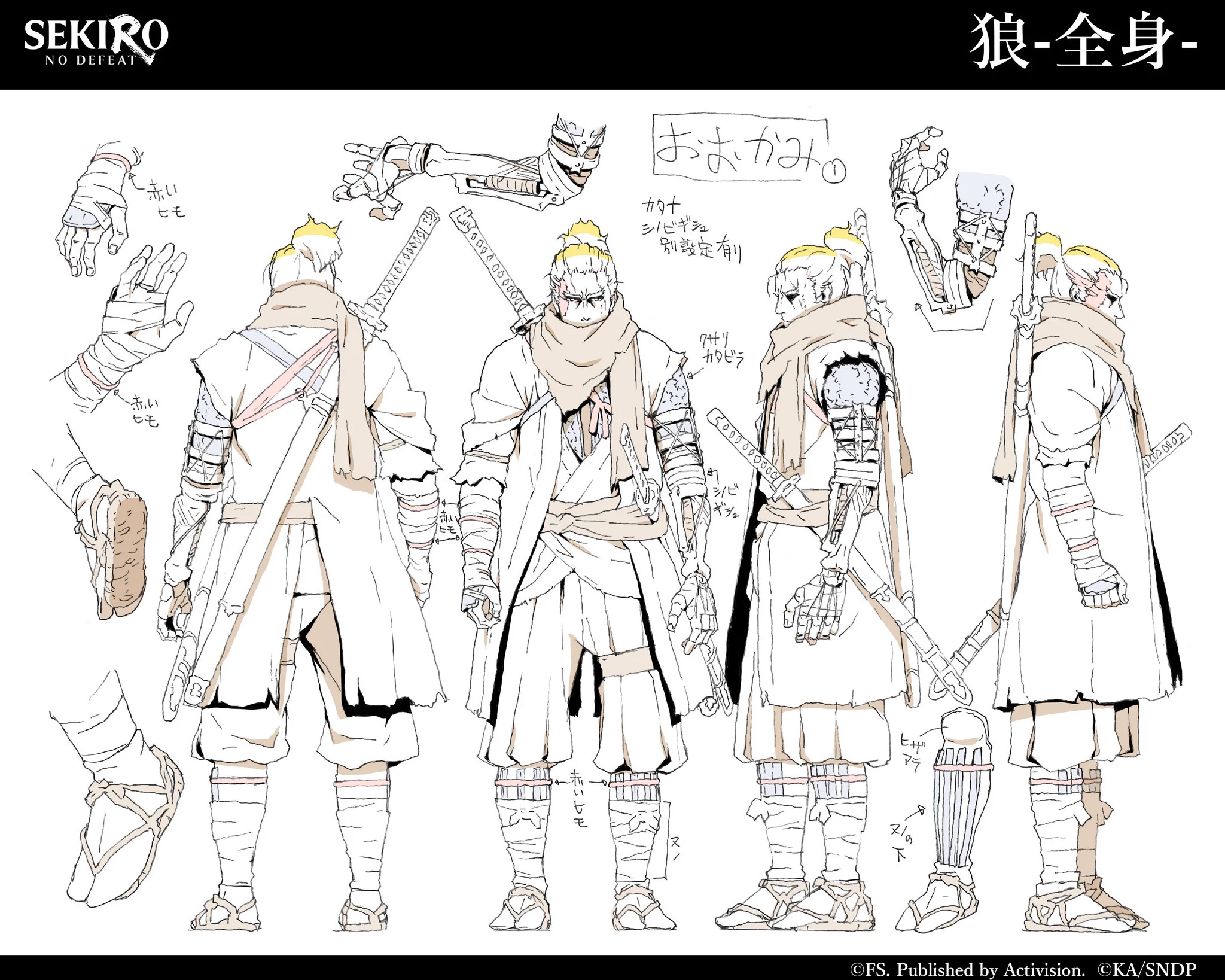
Chara design sheets posted by the Sekiro team on social media
Now, the problem with such complex designs is that it’s a huge burden on the animators, and the chief animation director in particular. Kutsuna first thought of Yūsuke Matsuo, but he was too busy to accept and recommended Kaito Moki in his place. Despite Moki’s young age, his skill immediately convinced Kutsuna, who gave him the job.
Due to the nature of Sekiro, the animation team would need another key member: an action animation director. This role went to Takashi Mukōda, a very expressive animator who prioritizes character over realism, and doesn’t shy away from deformed drawings. He met Kutsuna while working on Gurren Lagann at Doga Kobo, and the director knew he would be a perfect match for his vision and Kishida’s rich chara design. The latest he’s already familiar with, having worked on some famous HAIKYU!! scenes. Slight mishap though: Mukōda’s idiosyncratic style was mistaken for AI on social media when the first trailer released a few months prior, leading to a whole controversy. And if you were wondering, yes, the staff was still very pissed about that.
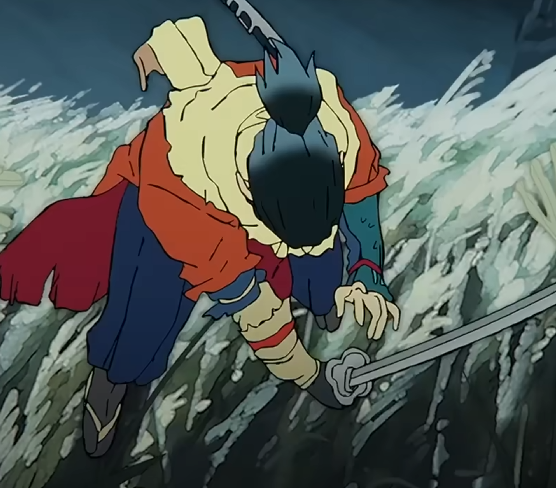
The “incriminating” frame… a simple coloring miss on the hand…
The animation looks fantastic nonetheless, and is well served by the work of art director Yūji Kaneko, a versatile artist who still draws his backgrounds by hand. His career spans an impressive variety of styles, from Little Witch Academia’s glamorous fantasy to Tengoku Daimakyo’s ruthless dystopia. Sekiro was a challenge: the beauty of the backgrounds that struck Kutsuna as he played relies on a sense of realism that can only exist in 3D. So Kaneko had to find his own way to convey the “Japanese beauty” of this world. And judging from the trailers alone, it looks like he went through his whole palette, as the expected realist touch stands alongside more symbolic or even impressionist backgrounds.
Unexpectedly, Kaneko also happened to share with assistant director Shunsuke Fukui a love for prog rock in general and King Crimson in particular, which the two of them bonded over!
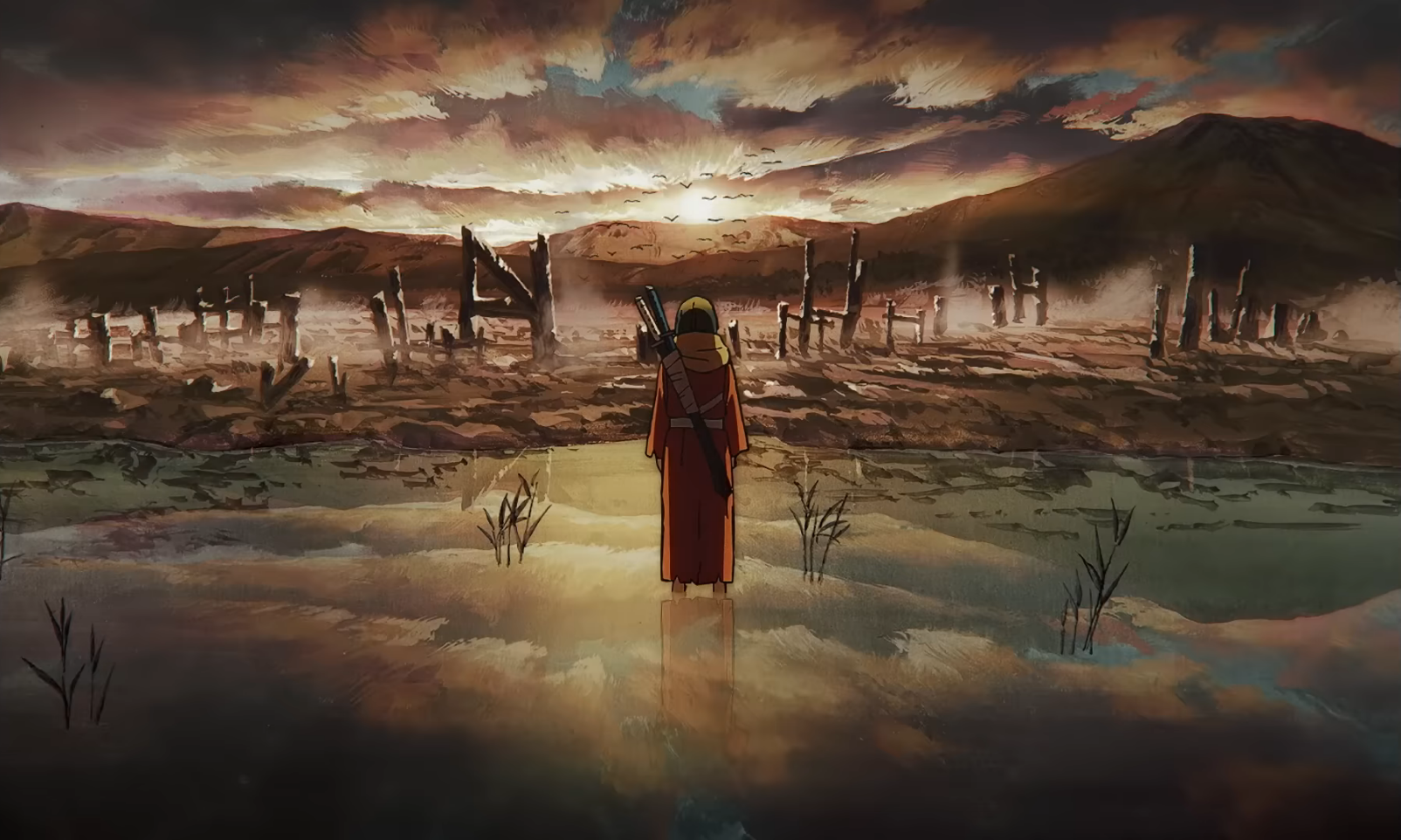
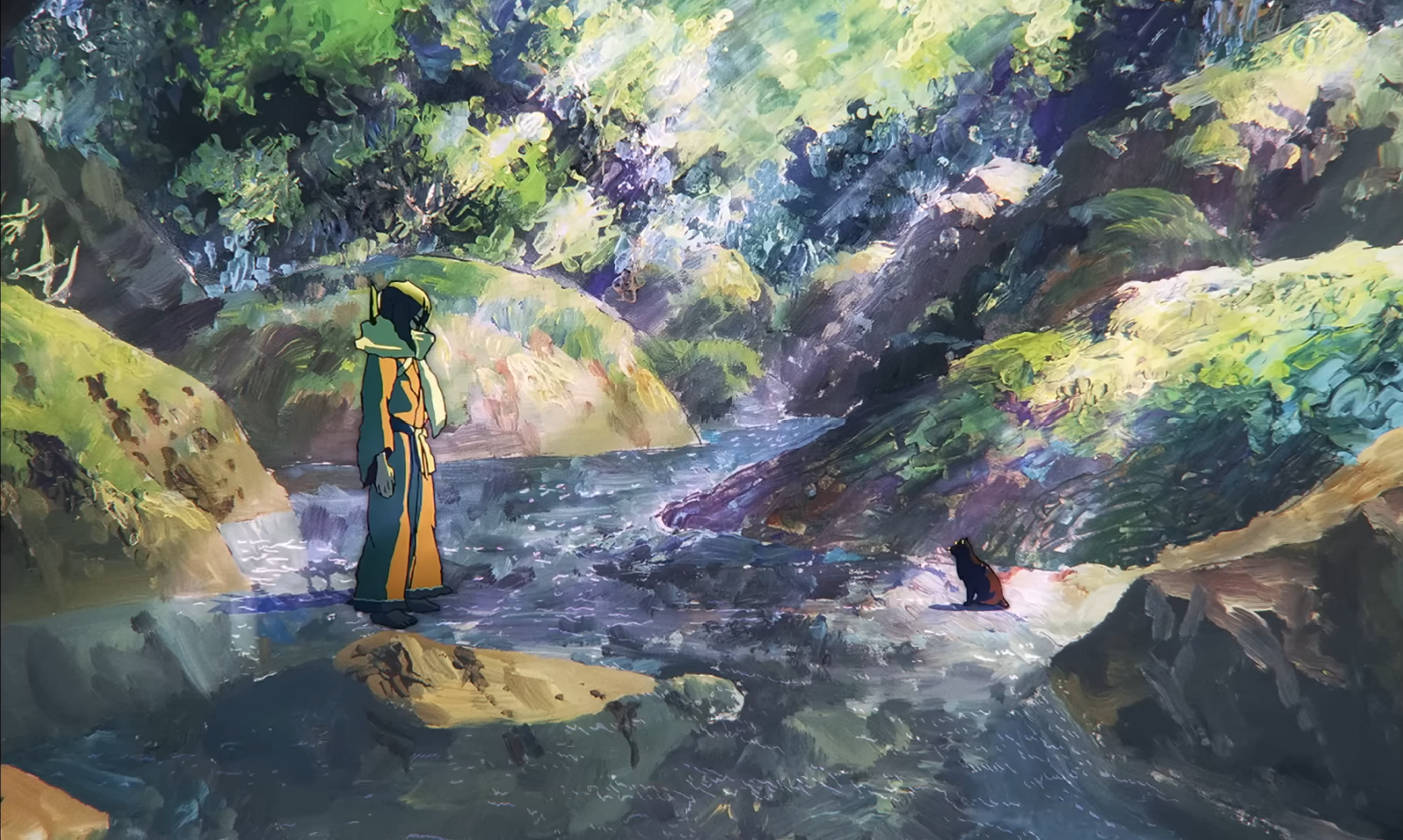
The range of Kaneko’s work, as showcased in the 2026 release trailer
In the art department, Sekiro has a very unique credit: Atsushi Harata’s “liquid art”. It’s appeared here and there in the trailers. Harata uses an OHP lens to create fluid animation. Kutsuna met him by complete chance at a dance performance by a friend of his wife (herself a dancer), the background of which was Harata’s fluid animation. Fluid mechanics are highly unpredictable, which is why it’s almost impossible to reproduce them on a computer. Kutsuna wanted this sort of “analog” performance in Sekiro.
Equally preoccupied with this organic feel for the music, he reached out to Shūta Hasunuma, a contemporary musician whose album unpeople had greatly impressed him by blending in analog recordings of unusual sounds.
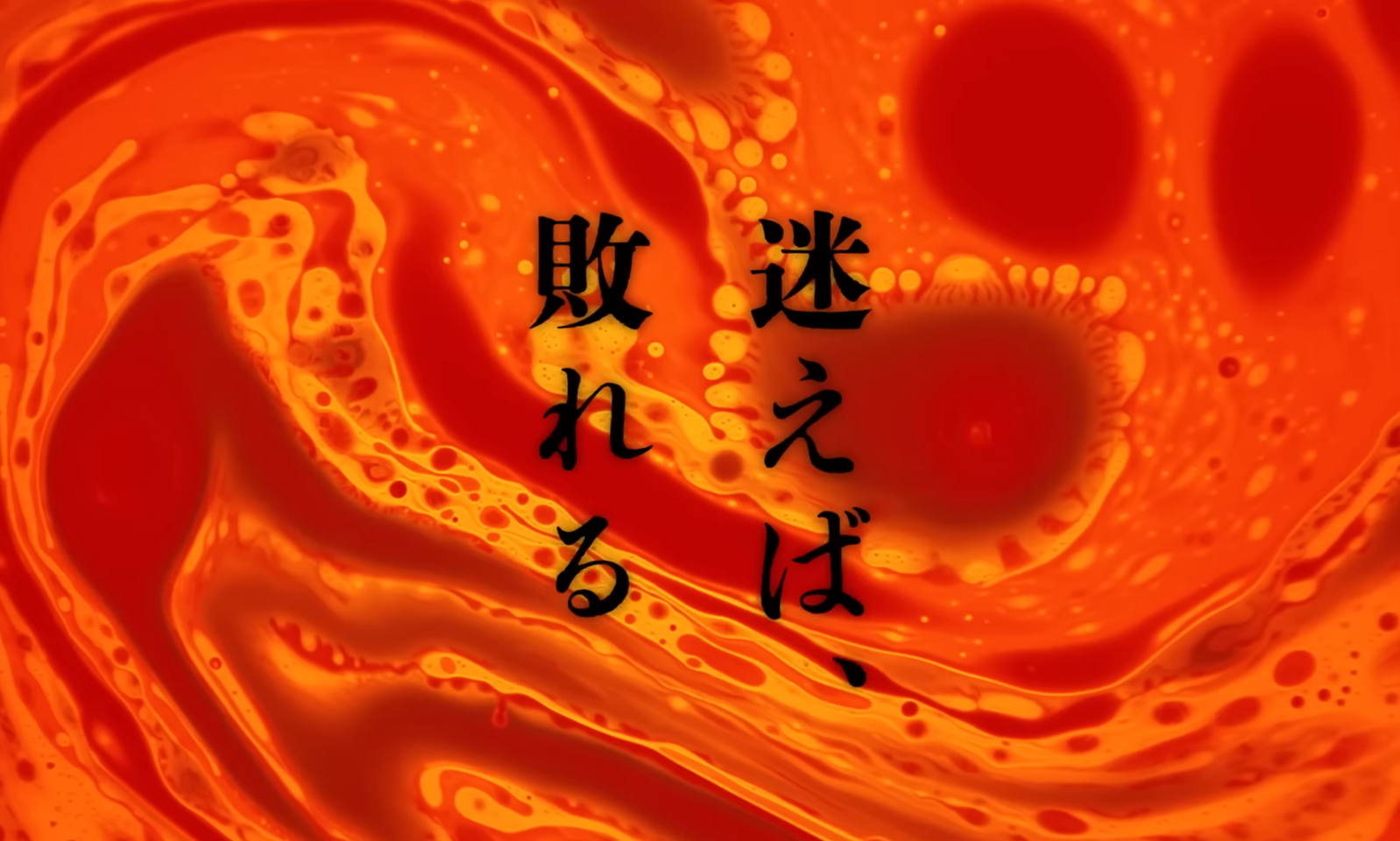
The series tagline, “If you falter, you lose”, written on Harata’s “liquid art” in the 2026 release trailer
With this staff, Kutsuna set out to recreate the sense of “Japanese beauty” that had struck him in the games. This meant research. For the action scenes in particular, the team reached out to a bujutsu expert (and YouTube content maker) to learn the way of the sword. For Kutsuna, the “physical” sense of holding and swinging a sword was essential to figure out the “rhythm” of a swordfighter, not only in terms of animation timing, but also of character acting. This could only be achieved through direct practice. Rather than a chanbara-type spectacle, Kutsuna wanted battle scenes that expressed the tension of impending death, a more realistic approach that matched the game. To this effect, the team also took time to study firearms from the Sekiro time period.
This meticulous research process was carried out throughout the production, starting before the script was even written and, for some specific scenes, continuing after the storyboard was done. Satō even went out on his own to study traditional Japanese housing, as well as rituals like the tea ceremony.
With that said, one can really feel the amount of time and dedication the staff put in Sekiro: No Defeat, and the trust the producers had in them. There is no doubt that this is a major project for all sides of the production, which is probably why it’s been in the works for such a long time. One last info from Kutsuna confirmed it: at the moment of the talk (2025, December 13th), animation was almost completed. Meaning that the series spent more than nine months in post-production and distribution planning, which, by anime industry standards, is really taking your sweet time. And we’re pretty sure it’s going to be worth it.
All our thanks go to director Kutsuna and the Sekiro: No Defeat team for sharing their wonderful work, and the Aichi Nagoya International Animation Film Festival for inviting us to their first edition. We will be back!
The second edition of the Aichi Nagoya International Animation Film Festival is being held from November 13th to 18th.
Written by Lilo Chiche
Like our content? Feel free to support us on Ko-Fi!
You might also be interested in
Benoît Chieux, a career in French animation [Carrefour du Cinéma d’Animation 2023]
Aside from the world-famous Annecy Festival, many smaller animation-related events take place in France over the years. One of the most interesting ones is the Carrefour du Cinéma d’Animation (Crossroads of Animation Film), held in Paris in late November. In 2023,...
Directing Mushishi and other spiraling stories – Hiroshi Nagahama and Uki Satake [Panels at Japan Expo Orléans 2023]
Last October, director Hiroshi Nagahama (Mushishi, The Reflection) and voice actress Uki Satake (QT in Space Dandy) were invited to Japan Expo Orléans, an event of a much smaller scale than the main event they organized in Paris. I was offered to host two of his...
Akira stories – Katsuhiro Otomo and Hiroyuki Kitakubo talk at Niigata International Animation Film Festival 2023
Among the many events taking place during the first Niigata International Animation Film Festival was a Katsuhiro Otomo retrospective, held to celebrate the 45th anniversary of Akira and to accompany the release of Otomo’s Complete Works. All of Otomo’s animated...
Recent Comments